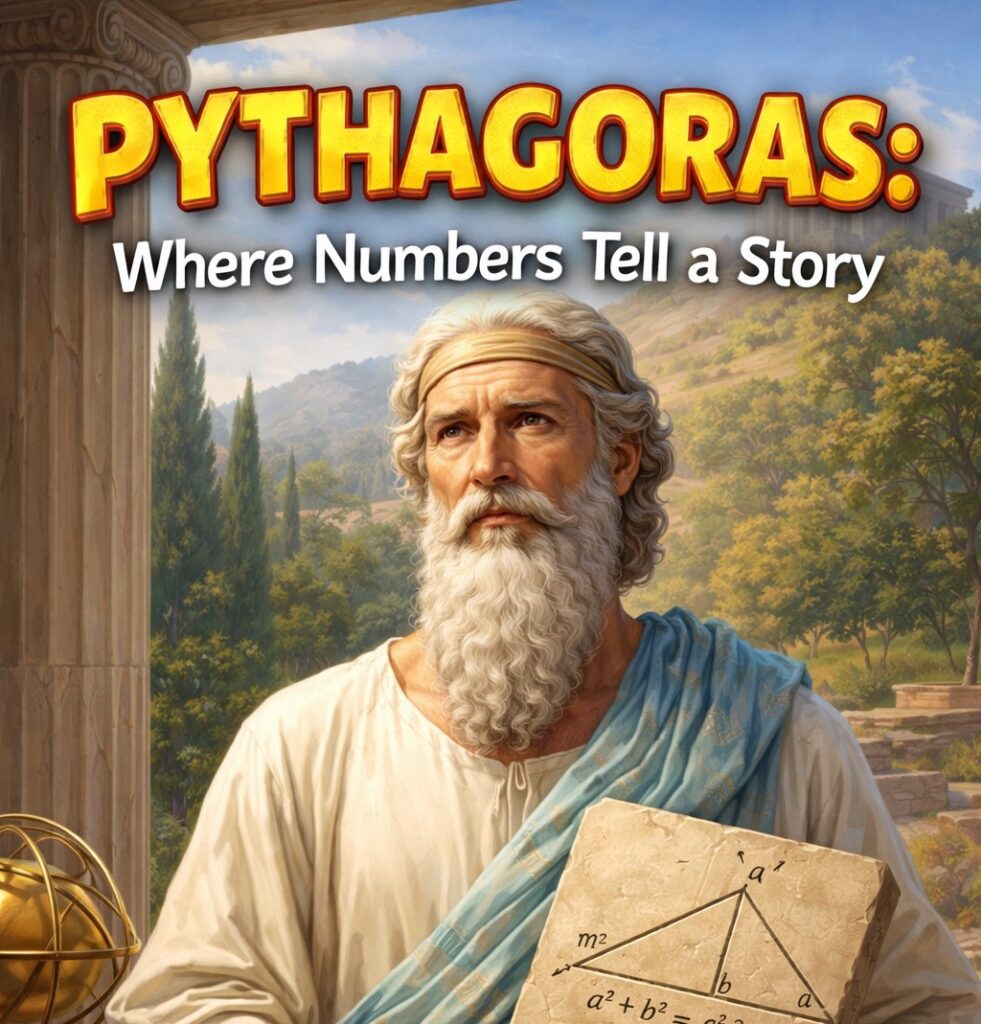
Pythagoras was born around 570 BC on the Greek island of Samos. From a young age, he was very curious and loved learning. People say he asked many questions about numbers, nature, and life itself. Even as a child, he believed that numbers were special and could explain how the world works.
As a young man, Pythagoras travelled far from home in search of knowledge. Around 550 BC, he went to Egypt, where he studied Mathematics, religion, and science from wise teachers. Later, he visited Babylon, where he learned more about numbers, stars, and astronomy. During these travels, he discovered that music and numbers are connected, especially in the sounds made by musical instruments.
By about 530 BC, Pythagoras settled in a town called Croton (in present-day Italy). There, he opened a famous school. His students were known as the Pythagoreans, and they lived a very disciplined life. Fun fact: new students were required to remain silent for several years and only listen before they were allowed to speak!
At his school, Pythagoras taught that numbers rule the universe. He believed Mathematics was not just for counting, but for understanding truth, order, and beauty. It was here that his most famous idea, now called Pythagoras’ Theorem, was taught and shared. Even though similar ideas existed before him, Pythagoras and his students helped prove the rule properly, making it very important in Mathematics.
Pythagoras died around 495 BC, but his ideas did not die with him. Because he never wrote books, everything we know about him was passed down by his students. More than 2,000 years later, his name is still remembered in classrooms all over the world.
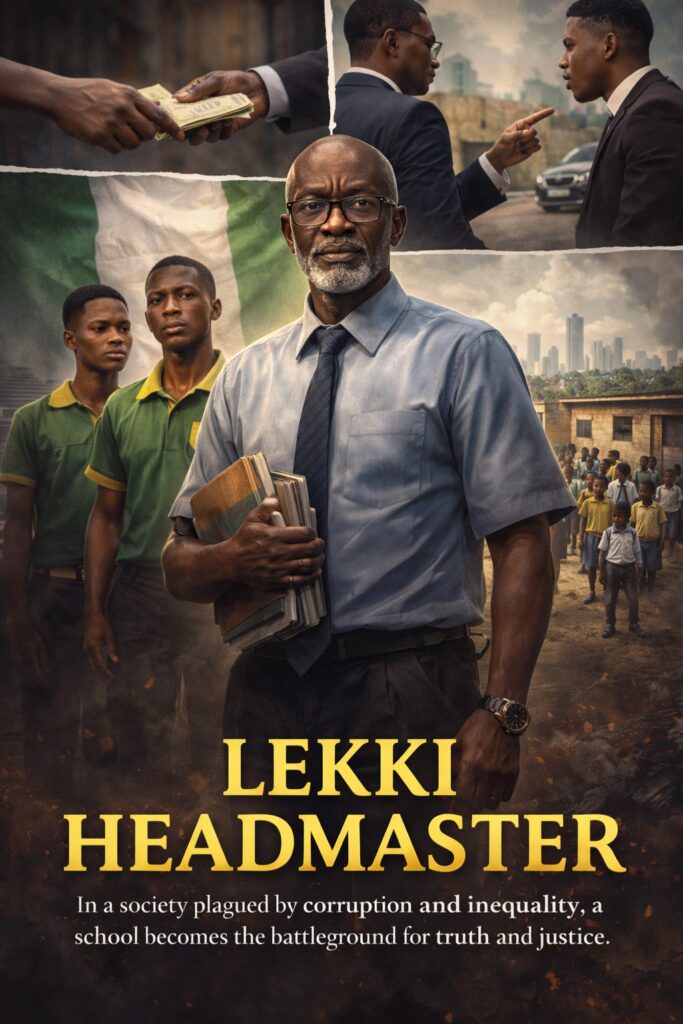
Lekki Headmaster by Kabir Alabi Garba is a socially reflective novel that uses the education system as a mirror through which the moral, social, and economic contradictions of modern Nigerian society are exposed. Through the experiences of the headmaster in an elite Lagos community, the novel examines how wealth, power, and moral compromise shape institutions that are meant to build character and nurture the future generation.
Corruption in the Education System
One of the most dominant themes in Lekki Headmaster is corruption, particularly within the education sector. The novel reveals that corruption is not always loud or violent; sometimes it appears quietly as financial mismanagement, favouritism, and deliberate disregard for ethical standards. The headmaster’s discovery of irregularities within the school administration shows that corruption has become deeply rooted in institutions that are meant to uphold discipline and integrity.
In Nigerian society, this reflects a painful reality. Many public institutions, including schools, are weakened by corrupt practices. Funds meant for development are misused, appointments are influenced by connections rather than competence, and honesty is often punished rather than rewarded. By portraying a school plagued by unethical behaviour, the novel suggests that the crisis of corruption in Nigeria begins from foundational institutions like education.
Abuse of Wealth and Power
The novel strongly condemns the misuse of wealth and social status. Parents in Lekki often believe that their financial influence places them above rules and authority. They interfere in school discipline, intimidate staff, and attempt to manipulate decisions in their favour. Education becomes a commodity rather than a moral process.
This theme closely mirrors Nigerian society, where wealth often determines access to justice, privilege, and protection. Influential individuals regularly bypass laws, silence opposition, and impose their will on public institutions. Lekki Headmaster shows that when wealth becomes a weapon, fairness and accountability disappear, leaving institutions vulnerable to decay.
Decline of Discipline and Moral Values
Another major theme is the breakdown of discipline, especially among the younger generation. The students in the novel are portrayed as intelligent but morally careless, largely because they are shielded by their parents’ wealth. Discipline is treated as an insult, and correction is seen as oppression.
This situation reflects a growing concern in society where discipline is often misunderstood as cruelty. Many parents defend wrongdoing instead of correcting it, raising children who lack respect for authority, responsibility, and empathy. The novel warns that a society that abandons discipline in the name of comfort is unknowingly nurturing future chaos.
Integrity versus Compromise
The headmaster represents integrity in a system that encourages compromise. He refuses to bend rules, manipulate records, or bow to pressure from powerful parents and officials. As a result, he faces hostility, isolation, and threats to his career.
This theme speaks directly to Nigerian society, where honesty often comes at a cost. Many people are pressured to compromise their values to survive professionally or socially. The novel questions a system that punishes integrity and rewards compromise, asking whether society can truly progress without moral courage.
Elitism and Social Inequality
Lekki, as portrayed in the novel, symbolizes privilege, luxury, and social separation. The contrast between the headmaster’s background and the environment he finds himself in highlights deep social inequality. Education in such elite spaces serves the interests of the wealthy rather than the broader society.
This theme reflects Nigeria’s sharp class divide, where access to quality education, healthcare, and opportunities is often determined by social class. The novel suggests that when education becomes elitist, it loses its power as a tool for social mobility and national development.
Tradition versus Modernity
The headmaster’s traditional values of discipline, respect, and moral responsibility clash with the modern, permissive culture of Lekki. This conflict reflects a society struggling to balance progress with values.
In contemporary Nigeria, modernization has brought comfort and exposure but has also weakened cultural and moral foundations. The novel does not reject modernity but warns against abandoning core values in the pursuit of sophistication
Leadership and Responsibility
Through the headmaster’s experiences, the novel emphasizes that leadership is not about position but responsibility. True leadership requires courage, fairness, and willingness to stand alone when necessary.
This message is particularly relevant in Nigerian society, where leadership failure is a recurring concern. The novel challenges leaders at all levels to prioritize service over personal gain.
Conclusion
Lekki Headmaster is not merely a story about a school; it is a powerful commentary on Nigerian society. Through themes of corruption, abuse of power, moral decay, integrity, and inequality, the novel exposes the struggles of individuals who choose honesty in a compromised system. It ultimately calls for a return to discipline, accountability, and ethical leadership as the foundation for national growth.
Research shows that students who write by hand remember information better than those who type.
Handwriting is more than putting words on paper, it actively shapes how the brain learns.
The slower pace of handwriting forces the brain to process ideas, not just copy them.
Writing by hand also strengthens fine motor skills, hand-eye coordination, and brain development in younger children. These skills are closely linked to reading ability and overall academic performance.
For older students, handwriting improves focus, comprehension, and idea organization. Notes written by hand are more likely to reflect understanding, not just transcription.
For parents, encouraging handwriting helps children build
patience,
discipline, and
confidence
skills that extend far beyond the classroom.
Technology is valuable, but handwriting builds the thinking foundation that technology depends on.
That’s it. Not demons. Not wizard math. Just adding small bits.
Imagine This Example
You have a bucket. Someone pours water into it very slowly, drop by drop.
You want to know:
How much water is inside after some time?
You can’t count each drop one by one — too many.
So you add all the tiny drops together.
That “adding small, small pieces” is integration.
See It Another Way
Imagine you’re painting a wall with tiny dots
Each dot is small, but together they fill the whole wall.
Integration = adding all the dots.
How Is Integration Connected to Differentiation?
Differentiation breaks things into tiny pieces (rates). Integration puts tiny pieces back together.
Differentiation = breaking
Integration = rebuilding
They’re opposites — like tying and untying shoelaces.
The Symbol for Integration
That long S-shaped symbol ∫means:
“Sum up everything.”
Differentiation helps us describe how fast something is changing (rate of change). Anti-differentiation (integration) helps us find the original quantity or the total accumulated amount from that rate.
So, if differentiation answers “How fast is it changing?”,
Anti-differentiation (Integration) answers
“How much has changed in total?” and “What original function produced this rate?”
Meaning of Anti-differentiation
If a function F(x) is such that
then F(x) is an antiderivative of f(x).
We write the indefinite integral as:
where C is the constant of integration.
Why do we add C?
Because many different functions have the same derivative.
For instance,
and
So the antiderivative of 2x is .
Basic Rules (Indefinite Integrals)
1. Power Rule
Add 1 to the power
Divide by the new power
Add + C
2. Constant Multiple Rule
3. Sum/Difference Rule
4. Important Special Case
Definite Integrals and Total Accumulation
This is the Fundamental Theorem of Calculus. It gives the total accumulated amount of f(x) from a to b. In many cases, it also represents area under the curve, but the “area” can mean real scientific quantities.