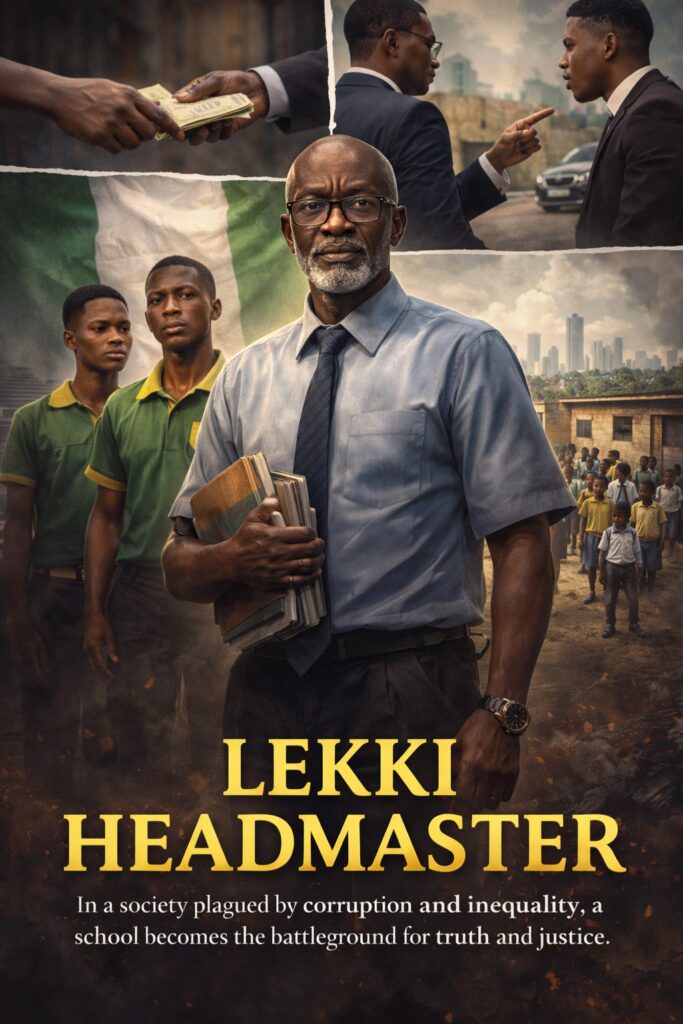
Lekki Headmaster by Kabir Alabi Garba is a socially reflective novel that uses the education system as a mirror through which the moral, social, and economic contradictions of modern Nigerian society are exposed. Through the experiences of the headmaster in an elite Lagos community, the novel examines how wealth, power, and moral compromise shape institutions that are meant to build character and nurture the future generation.
Corruption in the Education System
One of the most dominant themes in Lekki Headmaster is corruption, particularly within the education sector. The novel reveals that corruption is not always loud or violent; sometimes it appears quietly as financial mismanagement, favouritism, and deliberate disregard for ethical standards. The headmaster’s discovery of irregularities within the school administration shows that corruption has become deeply rooted in institutions that are meant to uphold discipline and integrity.
In Nigerian society, this reflects a painful reality. Many public institutions, including schools, are weakened by corrupt practices. Funds meant for development are misused, appointments are influenced by connections rather than competence, and honesty is often punished rather than rewarded. By portraying a school plagued by unethical behaviour, the novel suggests that the crisis of corruption in Nigeria begins from foundational institutions like education.
Abuse of Wealth and Power
The novel strongly condemns the misuse of wealth and social status. Parents in Lekki often believe that their financial influence places them above rules and authority. They interfere in school discipline, intimidate staff, and attempt to manipulate decisions in their favour. Education becomes a commodity rather than a moral process.
This theme closely mirrors Nigerian society, where wealth often determines access to justice, privilege, and protection. Influential individuals regularly bypass laws, silence opposition, and impose their will on public institutions. Lekki Headmaster shows that when wealth becomes a weapon, fairness and accountability disappear, leaving institutions vulnerable to decay.
Decline of Discipline and Moral Values
Another major theme is the breakdown of discipline, especially among the younger generation. The students in the novel are portrayed as intelligent but morally careless, largely because they are shielded by their parents’ wealth. Discipline is treated as an insult, and correction is seen as oppression.
This situation reflects a growing concern in society where discipline is often misunderstood as cruelty. Many parents defend wrongdoing instead of correcting it, raising children who lack respect for authority, responsibility, and empathy. The novel warns that a society that abandons discipline in the name of comfort is unknowingly nurturing future chaos.
Integrity versus Compromise
The headmaster represents integrity in a system that encourages compromise. He refuses to bend rules, manipulate records, or bow to pressure from powerful parents and officials. As a result, he faces hostility, isolation, and threats to his career.
This theme speaks directly to Nigerian society, where honesty often comes at a cost. Many people are pressured to compromise their values to survive professionally or socially. The novel questions a system that punishes integrity and rewards compromise, asking whether society can truly progress without moral courage.
Elitism and Social Inequality
Lekki, as portrayed in the novel, symbolizes privilege, luxury, and social separation. The contrast between the headmaster’s background and the environment he finds himself in highlights deep social inequality. Education in such elite spaces serves the interests of the wealthy rather than the broader society.
This theme reflects Nigeria’s sharp class divide, where access to quality education, healthcare, and opportunities is often determined by social class. The novel suggests that when education becomes elitist, it loses its power as a tool for social mobility and national development.
Tradition versus Modernity
The headmaster’s traditional values of discipline, respect, and moral responsibility clash with the modern, permissive culture of Lekki. This conflict reflects a society struggling to balance progress with values.
In contemporary Nigeria, modernization has brought comfort and exposure but has also weakened cultural and moral foundations. The novel does not reject modernity but warns against abandoning core values in the pursuit of sophistication
Leadership and Responsibility
Through the headmaster’s experiences, the novel emphasizes that leadership is not about position but responsibility. True leadership requires courage, fairness, and willingness to stand alone when necessary.
This message is particularly relevant in Nigerian society, where leadership failure is a recurring concern. The novel challenges leaders at all levels to prioritize service over personal gain.
Conclusion
Lekki Headmaster is not merely a story about a school; it is a powerful commentary on Nigerian society. Through themes of corruption, abuse of power, moral decay, integrity, and inequality, the novel exposes the struggles of individuals who choose honesty in a compromised system. It ultimately calls for a return to discipline, accountability, and ethical leadership as the foundation for national growth.