Category: Uncategorized
-
PYTHAGORAS – The man who measured the world
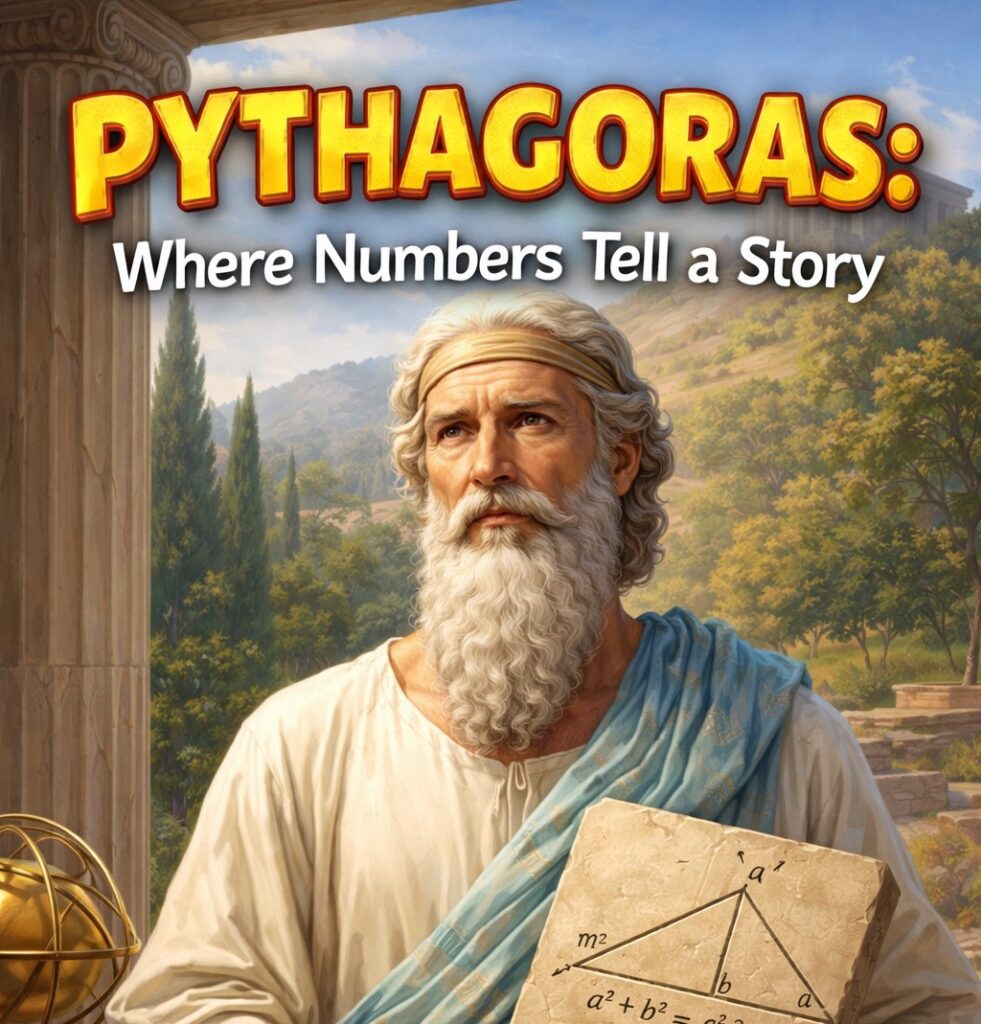
Where Numbers Tell a Story
Pythagoras was born around 570 BC on the Greek island of Samos. From a young age, he was very curious and loved learning. People say he asked many questions about numbers, nature, and life itself. Even as a child, he believed that numbers were special and could explain how the world works.
As a young man, Pythagoras travelled far from home in search of knowledge. Around 550 BC, he went to Egypt, where he studied Mathematics, religion, and science from wise teachers. Later, he visited Babylon, where he learned more about numbers, stars, and astronomy. During these travels, he discovered that music and numbers are connected, especially in the sounds made by musical instruments.
By about 530 BC, Pythagoras settled in a town called Croton (in present-day Italy). There, he opened a famous school. His students were known as the Pythagoreans, and they lived a very disciplined life. Fun fact: new students were required to remain silent for several years and only listen before they were allowed to speak!
At his school, Pythagoras taught that numbers rule the universe. He believed Mathematics was not just for counting, but for understanding truth, order, and beauty. It was here that his most famous idea, now called Pythagoras’ Theorem, was taught and shared. Even though similar ideas existed before him, Pythagoras and his students helped prove the rule properly, making it very important in Mathematics.

Pythagoras died around 495 BC, but his ideas did not die with him. Because he never wrote books, everything we know about him was passed down by his students. More than 2,000 years later, his name is still remembered in classrooms all over the world.